FIVE Q DROPS. ONE RECURRING NAME.
Alex Kaplan, Media Matters, and the Battle to Define the Narrative

When political advocacy dresses itself in the language of neutral research, the label can become more powerful than the evidence.
There is a strange creature living in modern American politics.
It isn’t quite journalism.
It isn’t quite activism.
It isn’t quite opposition research.
But somehow it has learned to wear the clothing of all three.
Organizations monitor social-media accounts.
They track political movements.
They catalog phrases.
They map associations.
They archive posts.
They connect people to other people.
Then they publish reports explaining who is supposedly connected to whom.
Journalists cite the reports.
Political activists repeat the labels.
Social-media users spread the headlines.
And suddenly a characterization becomes accepted as fact.
One of the researchers operating in this world is Alex Kaplan of Media Matters for America.
According to his official biography, Kaplan is a senior researcher whose focus includes social-media misinformation, disinformation, and online extremism. His bio says he joined Media Matters in March 2015.
That sounds clinical.
Academic.
Detached.
But before treating Media Matters like an impartial referee standing above America’s political battlefield, readers should understand something important.
Media Matters has a stated ideological mission.
The organization describes itself as a progressive research and information center dedicated to monitoring, analyzing, and correcting conservative misinformation in American media.
That’s not a secret.
That’s not a conspiracy theory.
That’s the organization’s stated mission.
And it raises a very simple question:
Why is the work of an openly progressive watchdog so often repeated downstream as though it originated from a politically neutral authority?
That question matters.
Because in the modern information war, the person applying the label may wield more power than the person being labeled.
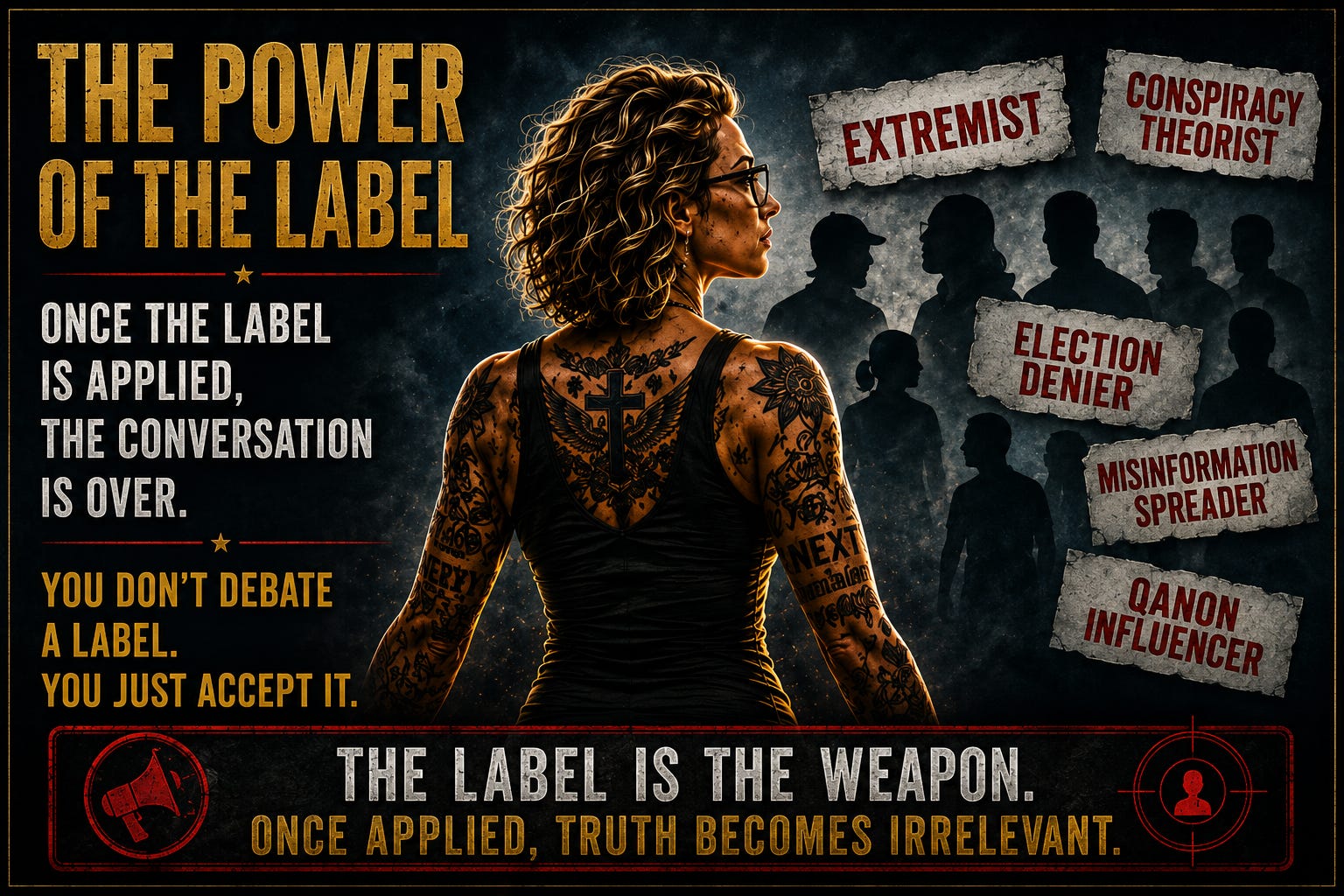
THE POWER OF THE LABEL
Modern political warfare often begins with a word.
Extremist.
Conspiracy theorist.
Election denier.
Disinformation spreader.
QAnon influencer. (As Mr. Kaplan refers to them.)
The label becomes a shortcut.
Once attached, the public is no longer encouraged to examine the person’s actual argument.
The label becomes the argument.
You don’t have to answer someone labeled a conspiracy theorist.
You don’t have to debate someone labeled an extremist.
You don’t have to investigate the claims of someone labeled a misinformation spreader.
You point to the label.
Conversation over.
Kaplan’s work has repeatedly examined QAnon-related communities (as he refers to them), election-denial networks, social-media accounts, political figures, and the amplification of accounts that Media Matters categorizes as QAnon-promoting(as he refers to them). In 2024, for example, he published a tally claiming Donald Trump had amplified QAnon(as he refers to them)-promoting accounts nearly 1,000 times on Truth Social; he has also warned reporters against accepting claims from QAnon supporters (as he refers to them) that the movement no longer exists.
But readers need to understand an important distinction.
Tracking is not the same thing as proving.
A screenshot can prove someone shared a post.
It does not automatically prove that person believes everything the original account has ever said.
Appearing at the same conference proves attendance.
It does not automatically prove ideological agreement with everyone in the building.
Following an account proves a follow.
It does not automatically prove endorsement.
Using the same phrase proves two people used the same phrase.
It does not automatically establish coordination.
These distinctions matter.
Because when distinctions disappear…
association becomes accusation.
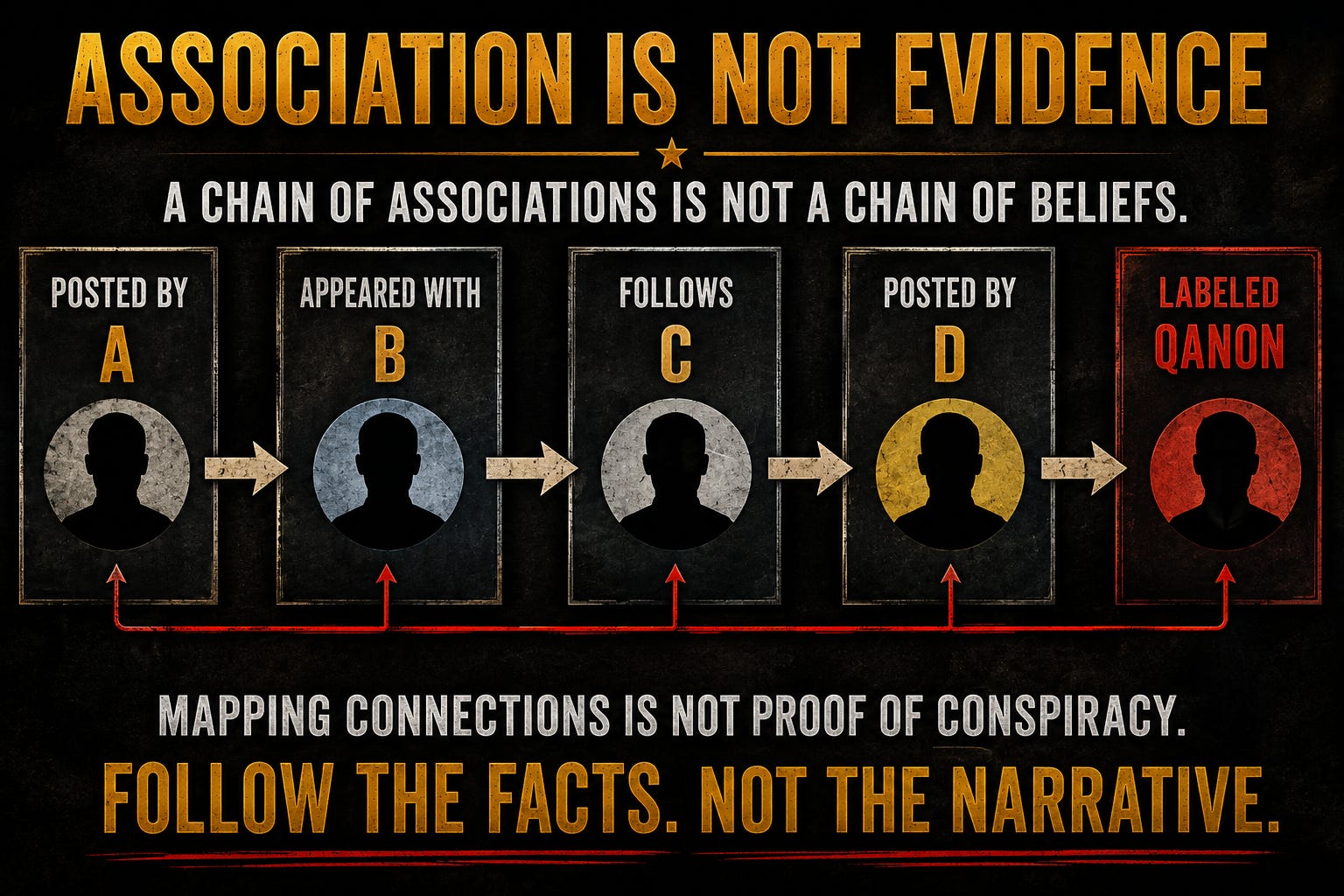
THE ASSOCIATION MACHINE
Imagine this scenario.
Person A reposts Person B.
Person B once appeared with Person C.
Person C follows Person D.
Person D has posted Q-related material.
A researcher builds a map.
The headline says:
“Growing ties between political activists and QAnon networks.”
Every individual connection might be real.
But what does the overall presentation cause the reader to believe?
That an organized ideological network has been established.
Maybe it has.
But the map itself doesn’t necessarily prove it.
Media Matters has explicitly presented Kaplan discussing what it called “growing ties” between QAnon (as he refers to it) and election-denial movements and the potential political consequences of those overlaps.
This is where readers should ask a simple question:
Are we being shown direct evidence of belief and coordination—or a collection of associations arranged to imply something larger?
Apply the same standard universally.
Map every journalist’s follows.
Map every politician’s reposts.
Map every activist’s conference appearances.
Map every donor.
Map every interview.
Map every person who has ever shared the same hashtag.
Then assign the most controversial belief found anywhere in the network to everyone standing within three digital handshakes.
Almost nobody survives that standard.
A connection may be relevant.
But a connection is not automatically a conclusion.
Association is not evidence of shared belief.
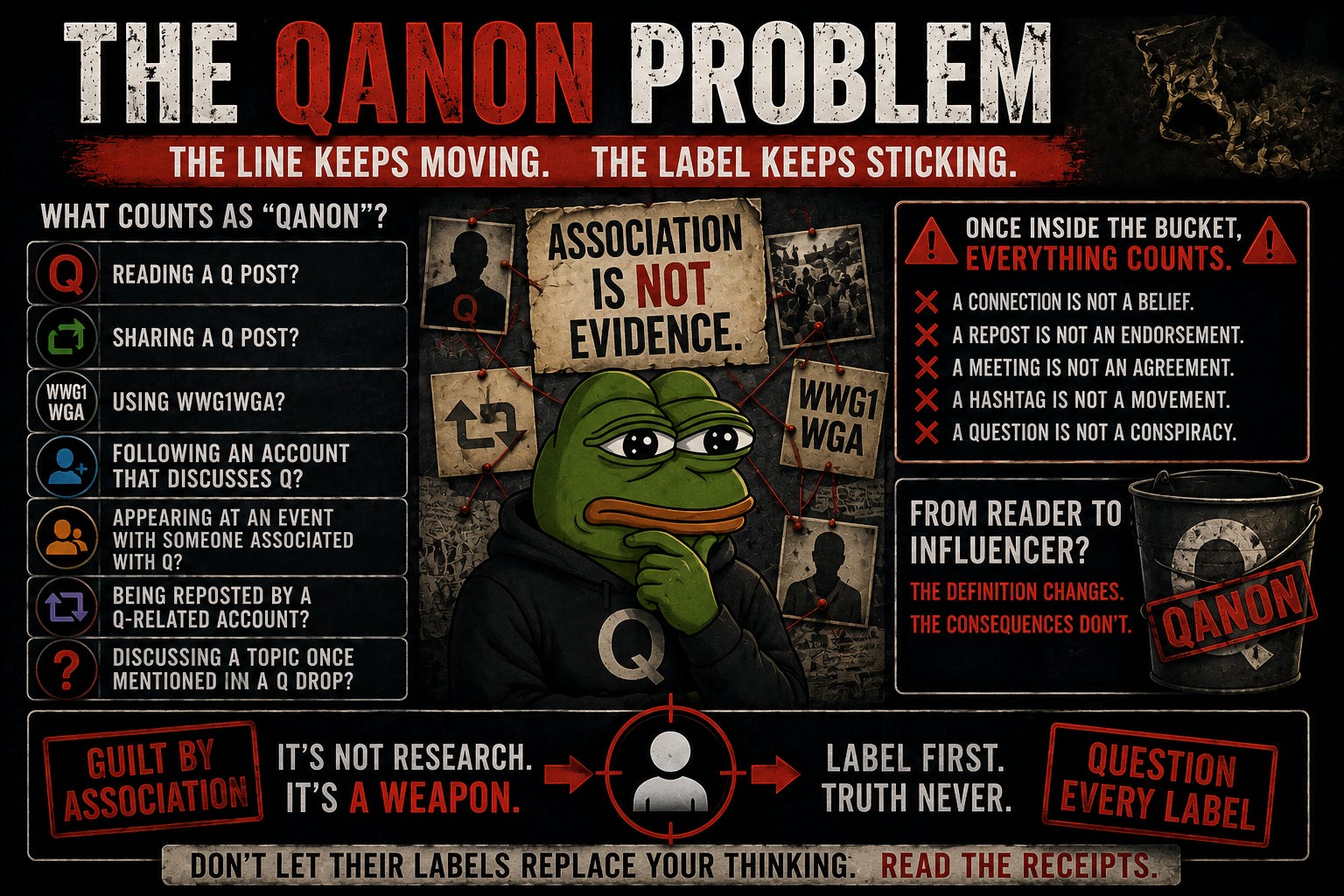
THE QANON PROBLEM
This brings us directly to Q.
Alex Kaplan has spent years examining and publishing about QAnon-related (as he refers to it) online activity.
His Media Matters work has covered QAnon communities(as he refers to them), Trump amplifications of QAnon-promoting accounts(as he refers to them), overlap with election-denial activism, and even the reactions of QAnon communities (as he refers ti them) to current political developments. As recently as January 2026, Kaplan was still publishing about QAnon-community (as he refers to them) reactions to official Department of Labor social-media posts.
But there is a deeper classification question that deserves scrutiny.
What exactly counts as QAnon(as he refers to it)?
Reading a Q post?
Sharing a Q post?
Using the letter Q?
Posting WWG1WGA?
Discussing a subject once mentioned in a Q drop?
Following an account that discusses Q?
Appearing at an event with someone associated with Q?
Being reposted by a Q-related account?
These are not interchangeable categories.
Yet public reporting can blur the boundaries between:
Q reader.
Q supporter.
Q influencer.
Q-promoting account.
QAnon-linked figure (as he refers to him/her).
Person followed by QAnon accounts (as he refers to them).
Once someone enters the ideological bucket, almost everything they do can be interpreted through that label.
That creates a circular problem.
They’re associated with Q because they share Q-related material.
What makes the material Q-related?
Because Q-associated people share it.
Around and around the labeling machine goes.
And this is where the historical record becomes especially interesting.
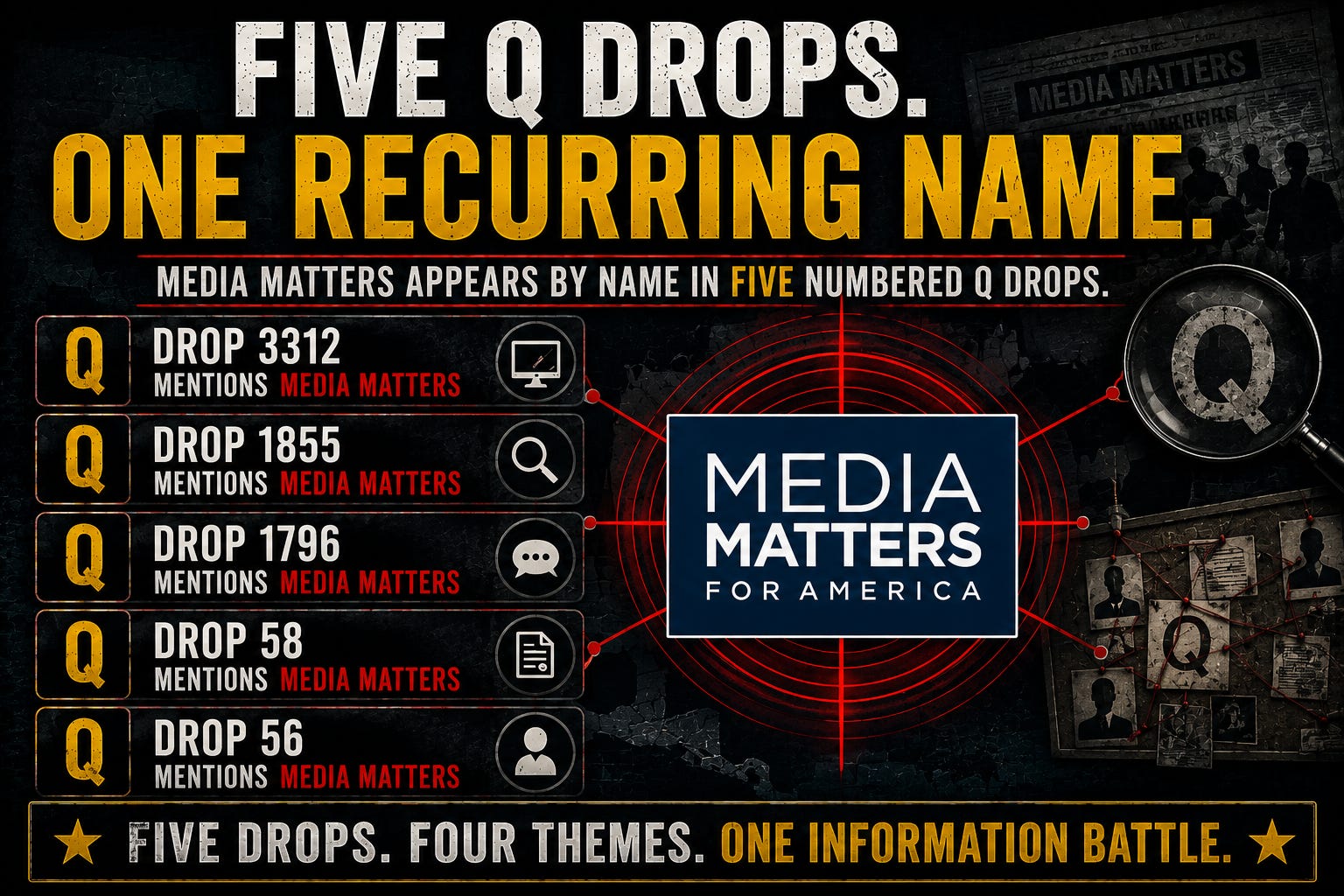
Because Media Matters itself appears by name in five numbered Q drops.
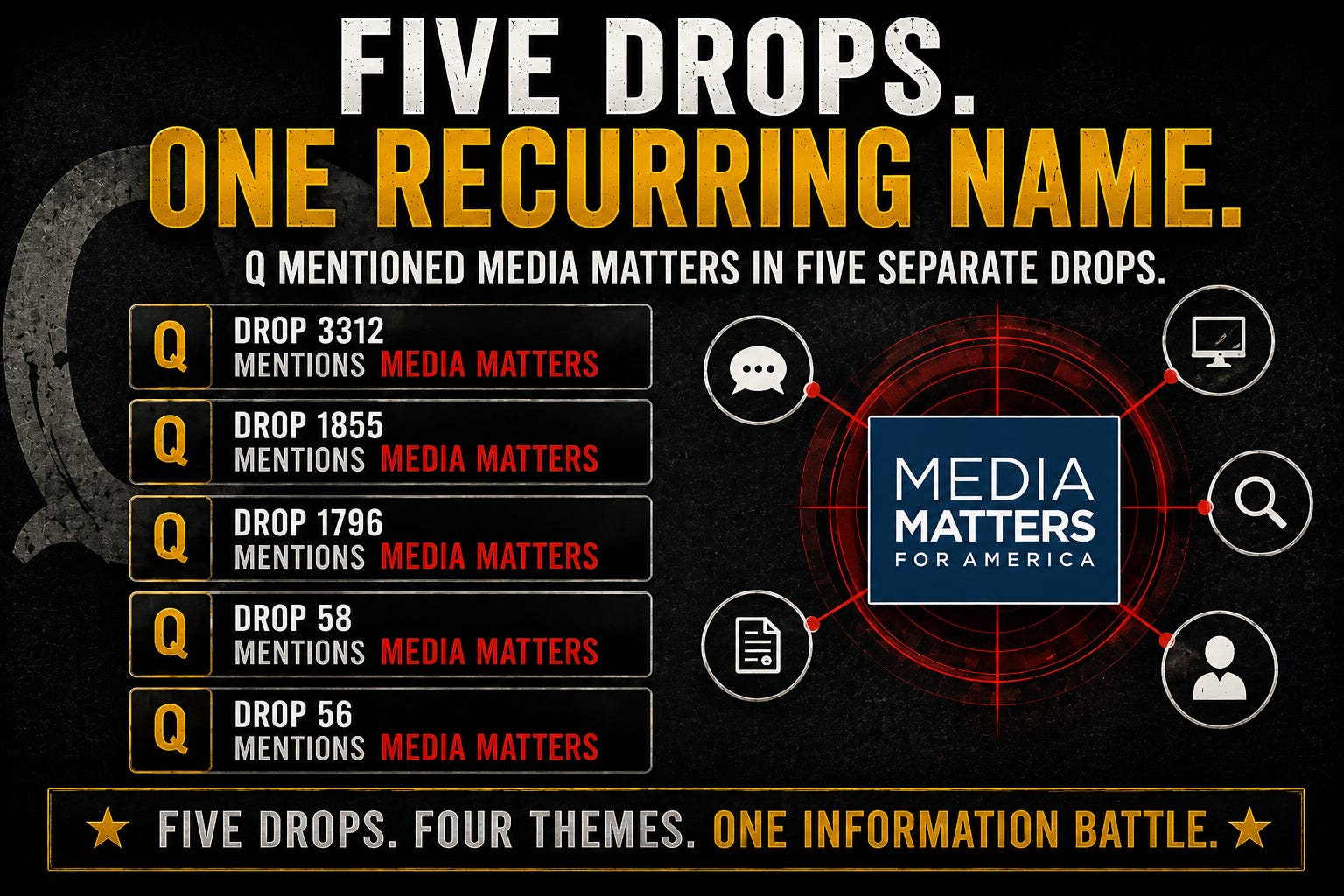
FIVE DROPS. ONE RECURRING NAME.
For people familiar with the Q drops, Media Matters isn’t a new arrival in this conversation.
The Q archive contains Media Matters references in:
Drop 3312.
Drop 1855.
Drop 1796.
Drop 58.
Drop 56.
One credibility note matters here.
Drops 56 and 58 contain the same Media Matters passage in the archive.
So we are looking at five numbered drops containing the name, but four distinct Media Matters themes or passages.
That does not prove every allegation made in those drops.
A Q post is not a court judgment.
It is not a subpoena.
It is not independently authenticated evidence of every claim it raises.
But if we’re examining the historical relationship between Q-related communities and Media Matters, pretending these references do not exist would leave out relevant context.
Q was discussing Media Matters years ago.
The better question isn’t:
“Does a Q drop automatically prove Media Matters did something?”
It doesn’t.
The better question is:
“What did the drops actually say—and how do those themes compare with the publicly observable work Media Matters later performed around Q-related networks?”
Read the timeline.
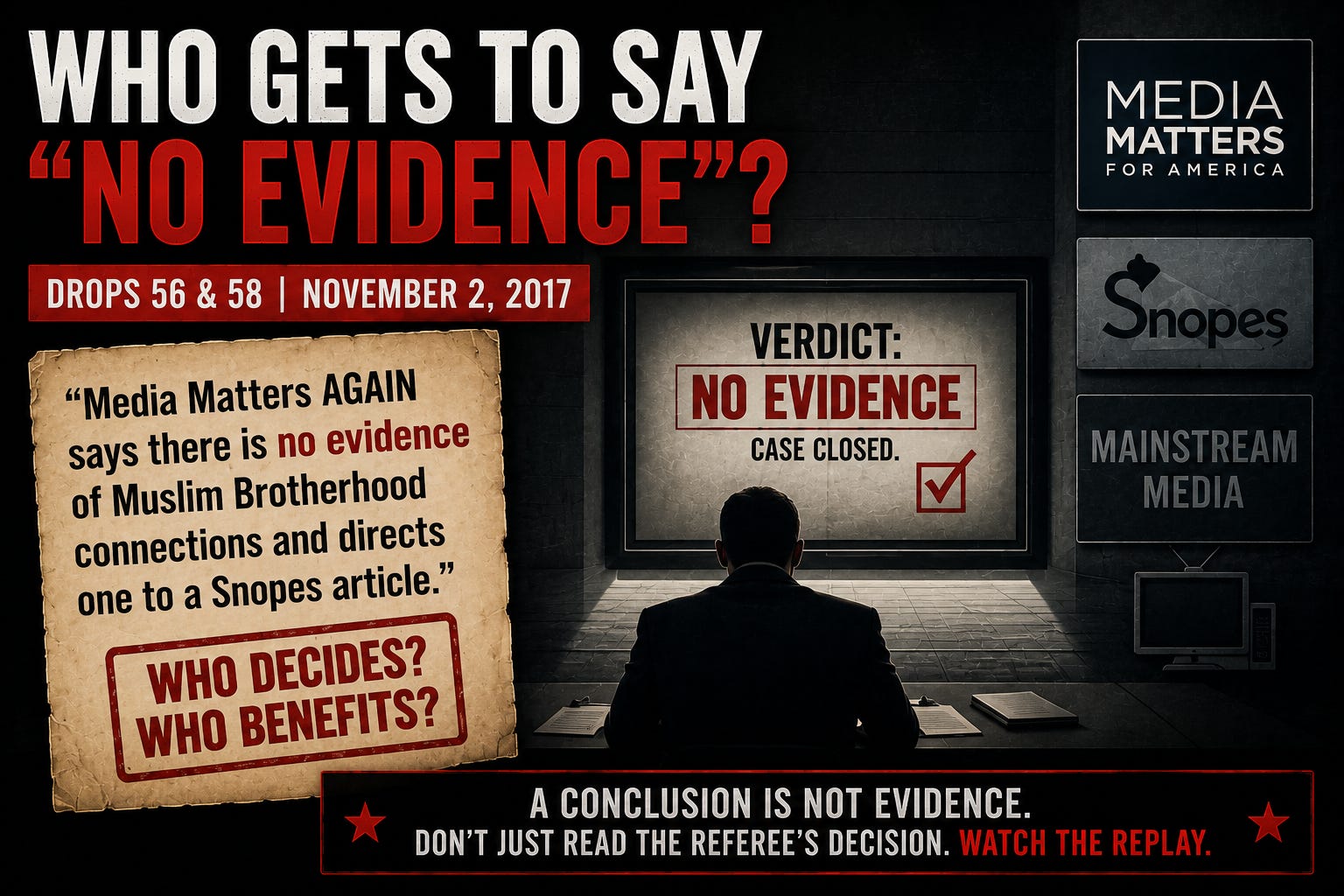
DROPS 56 AND 58 — WHO GETS TO SAY “NO EVIDENCE”?
Drops 56 and 58, dated November 2, 2017, contain the same passage concerning Media Matters.
The archived text calls Media Matters a “Clinton surrogate group” and challenges its treatment of allegations concerning Huma Abedin and claimed Muslim Brotherhood connections. The passage criticizes Media Matters’ use of “no evidence” language and its reliance on a Snopes fact-check in that dispute.
To be clear:
The underlying allegation should not be declared true merely because Q repeated or discussed it.
But the information mechanism being challenged is relevant to this article.
Who gets to declare:
“No evidence”?
What sources were examined?
What standard of evidence was applied?
Was contradictory information addressed?
Was the original claim presented accurately?
Could a reader independently inspect the material?
Or was the audience given a conclusion and encouraged to move on?
The phrase “no evidence” may be an accurate conclusion.
But the phrase itself is not evidence.
The work still has to be shown.
The methodology still matters.
This is why Drops 56 and 58 are relevant.
They raise an early version of the same question this article asks:
Should we simply accept the referee’s decision—or examine the replay?
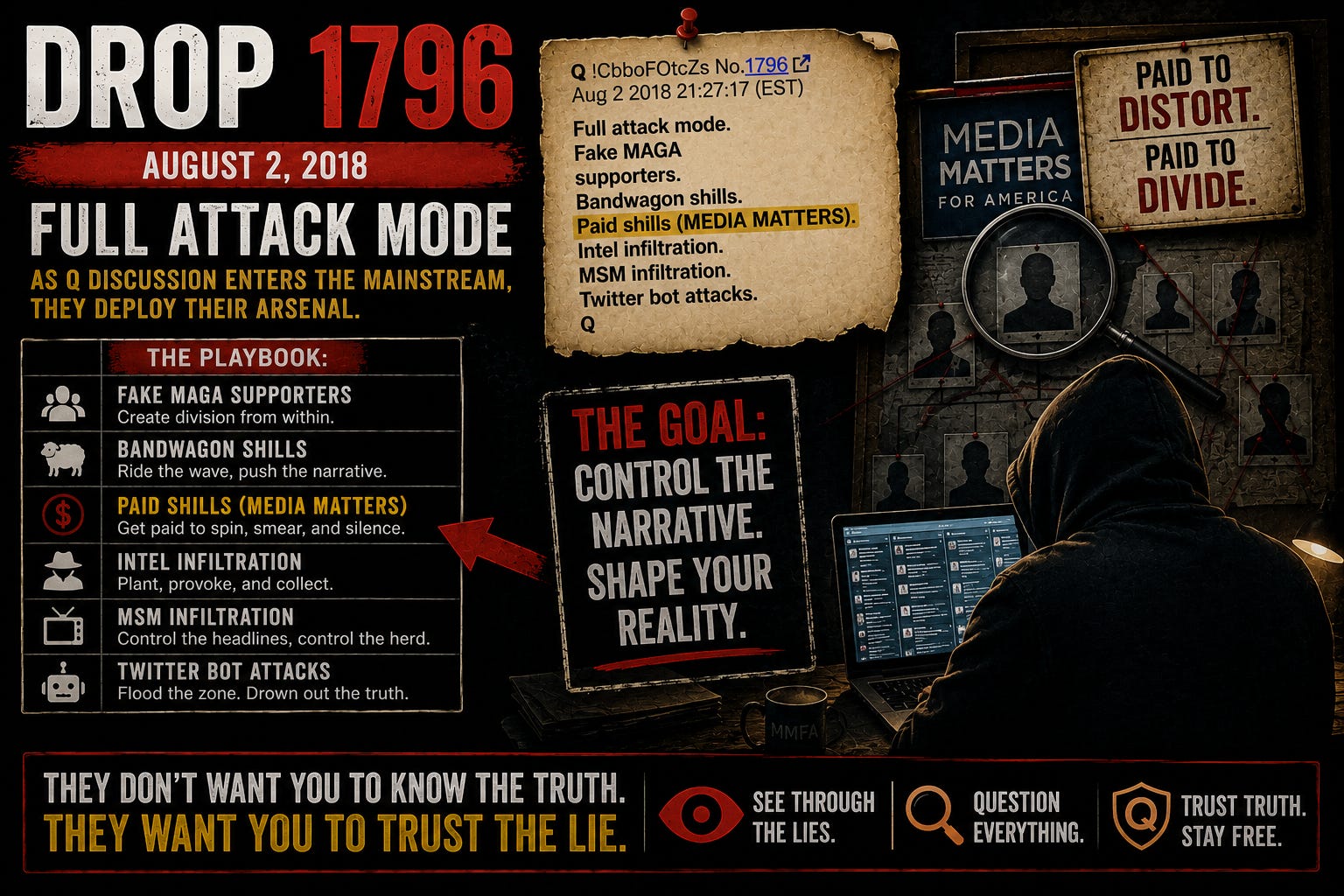
DROP 1796 — “PAID SHILLS (MEDIA MATTERS)”
By August 2, 2018, the language had become much more direct.
Drop 1796 described what it called “full attack mode” as Q-related discussion entered broader public awareness.
The archived drop listed anticipated or alleged forces including fake MAGA supporters, bandwagon shills, “Paid shills (Media Matters),” intelligence infiltration, mainstream-media infiltration, and Twitter bot attacks.
Again, preserve the distinction.
The drop asserts this.
The archive does not, by itself, independently prove a paid-disruption operation.
But compare the theme with Media Matters’ publicly stated work.
Media Matters openly monitors and analyzes conservative media and what it classifies as misinformation. Kaplan’s own official biography says his research focuses on social-media misinformation, disinformation, and online extremism.
The observable activity is monitoring and analysis.
The disagreement concerns purpose, framing, and methodology.
Media Matters sees watchdog research.
Critics may see ideological opposition research.
Those are radically different interpretations of some of the same public activity.
So ask:
Who is monitored?
Why are particular people selected?
How are they categorized?
What transforms a person from someone who discussed Q into a “QAnon influencer”?
Are direct statements examined?
Or are associations mapped?
Are identical standards applied to ideological movements on the left?
Drop 1796 matters because it demonstrates that by 2018, Q was explicitly placing Media Matters inside the battle over online narratives.
Years later, Media Matters became a persistent institutional tracker of Q-related communities and political overlap.
That timeline is relevant.
Relevant does not mean proven conspiracy.
It means the timeline deserves examination.
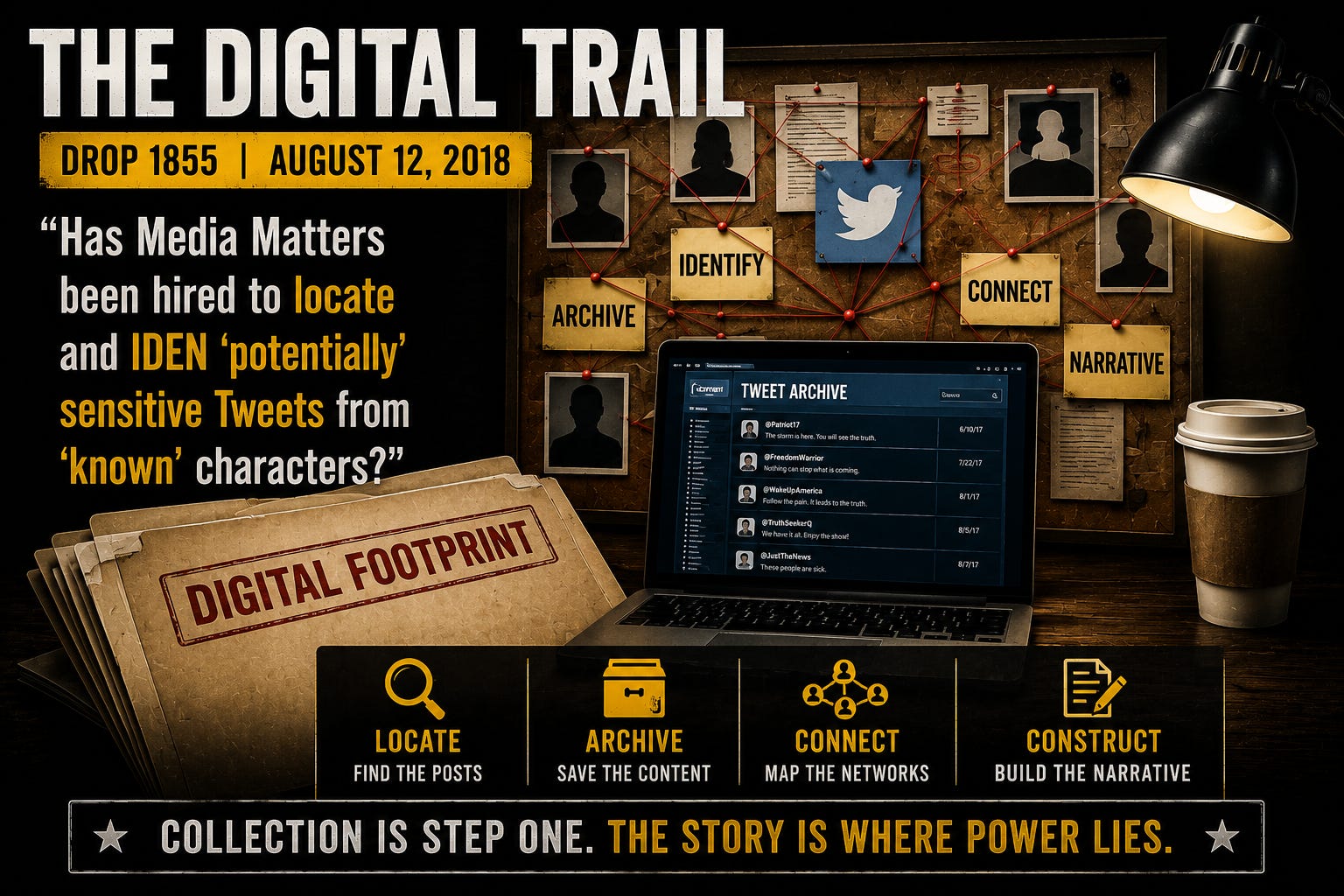
DROP 1855 — THE DIGITAL TRAIL
Drop 1855, dated August 12, 2018, asks:
“Has Media Matters been hired to locate and IDEN ‘potentially’ sensitive Tweets from ‘known’ characters?”
The same drop also raises questions concerning NBC and the removal of “potentially sensitive Tweets.”
Read the grammar carefully.
It’s a question.
Not a court finding.
Not documentary proof of a contract.
Not confirmation that Media Matters was hired for the alleged purpose.
A question.
We should not quietly upgrade a question into an established fact.
But the question is remarkably relevant to the modern information ecosystem.
Because what does contemporary digital media research frequently involve?
Locating posts.
Archiving statements.
Tracking accounts.
Identifying connections.
Cataloging content.
Comparing timelines.
Connecting public figures with previous online activity.
Kaplan’s published work provides visible examples of this kind of monitoring and categorization around QAnon-related accounts and networks(as he refers to them).
That does not prove the specific hiring theory posed in Drop 1855.
But it explains why the question resonates.
The internet created an extraordinary form of political research.
Your tweet from seven years ago.
A deleted Facebook post.
A podcast appearance.
A photograph at a conference.
An account you followed.
A person who reposted you.
A phrase you used.
All of it can be:
Located.
Archived.
Connected.
Then placed inside a narrative.
Sometimes that process exposes genuine misconduct.
Sometimes it documents an important political network.
Sometimes it reveals hypocrisy.
And sometimes it becomes a guilt-by-association machine.
Collection is step one.
The story constructed from the collection is where power enters the equation.
That’s why Drop 1855 matters to this discussion.
It points directly at the question of the digital trail.
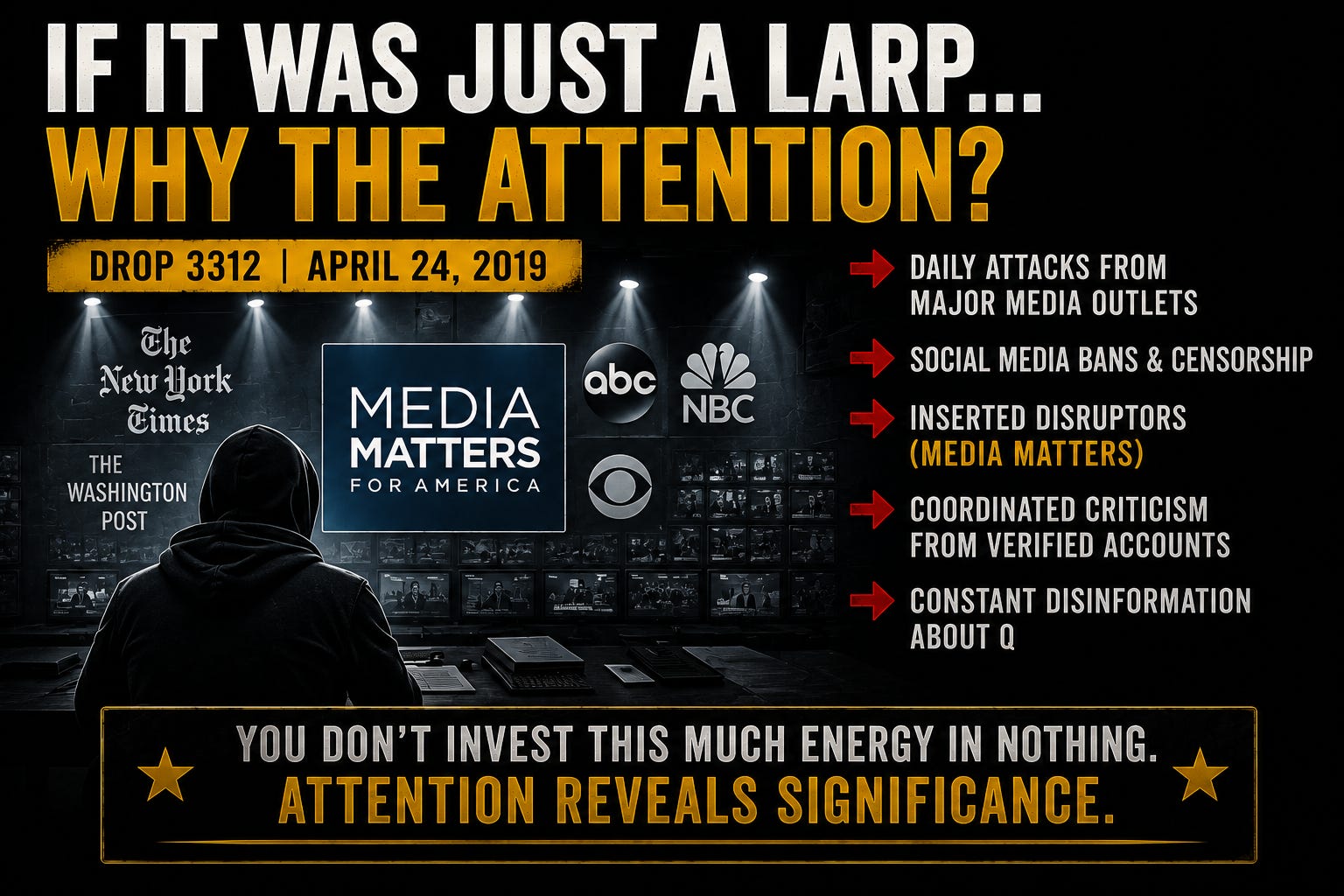
DROP 3312 — IF IT WAS JUST A LARP, WHY THE ATTENTION?
Then comes Drop 3312.
The archived text asks why, if Q were merely a “LARP asking questions on the Chans,” Q was facing daily attacks from major media companies, social-media censorship or banning, alleged paid or inserted disruptors—with “media matters” in parentheses—and coordinated attacks from verified accounts.
The drop asks why there was a constant flow of disinformation about Q.
This may be the most directly relevant Q drop to an article concerning Alex Kaplan.
Because the drop presents a paradox from Q’s perspective:
If Q was meaningless nonsense, why devote so much attention to it?
Now apply discipline here.
Attention is not validation.
The fact that journalists, researchers, academics, technology companies, or government agencies study a movement does not prove the movement’s claims.
But attention does establish something else:
Significance.
Media Matters has spent years documenting QAnon-related activity (as they refer to it).
Kaplan has written about QAnon communities(as he refers to them), QAnon-promoting accounts (as he refers to them), election-denial overlap, political candidates, Trump amplifications, and the continuing presence of Q-related narratives.
So the historical question remains interesting.
Why so much attention?
Maybe researchers believed Q-related narratives presented a misinformation problem.
Maybe they believed the movement had genuine political influence.
Maybe they were concerned about extremism.
Maybe ideological opposition played a role.
Maybe motivations varied by organization and researcher.
Those possibilities should be investigated rather than assumed.
But you cannot reasonably describe a phenomenon as politically insignificant while simultaneously documenting its accounts, language, communities, candidates, and political reach for years.
Drop 3312’s question therefore survives even if a reader rejects every larger theory surrounding Q:
Why the attention?
A serious researcher should be capable of answering that question with evidence.
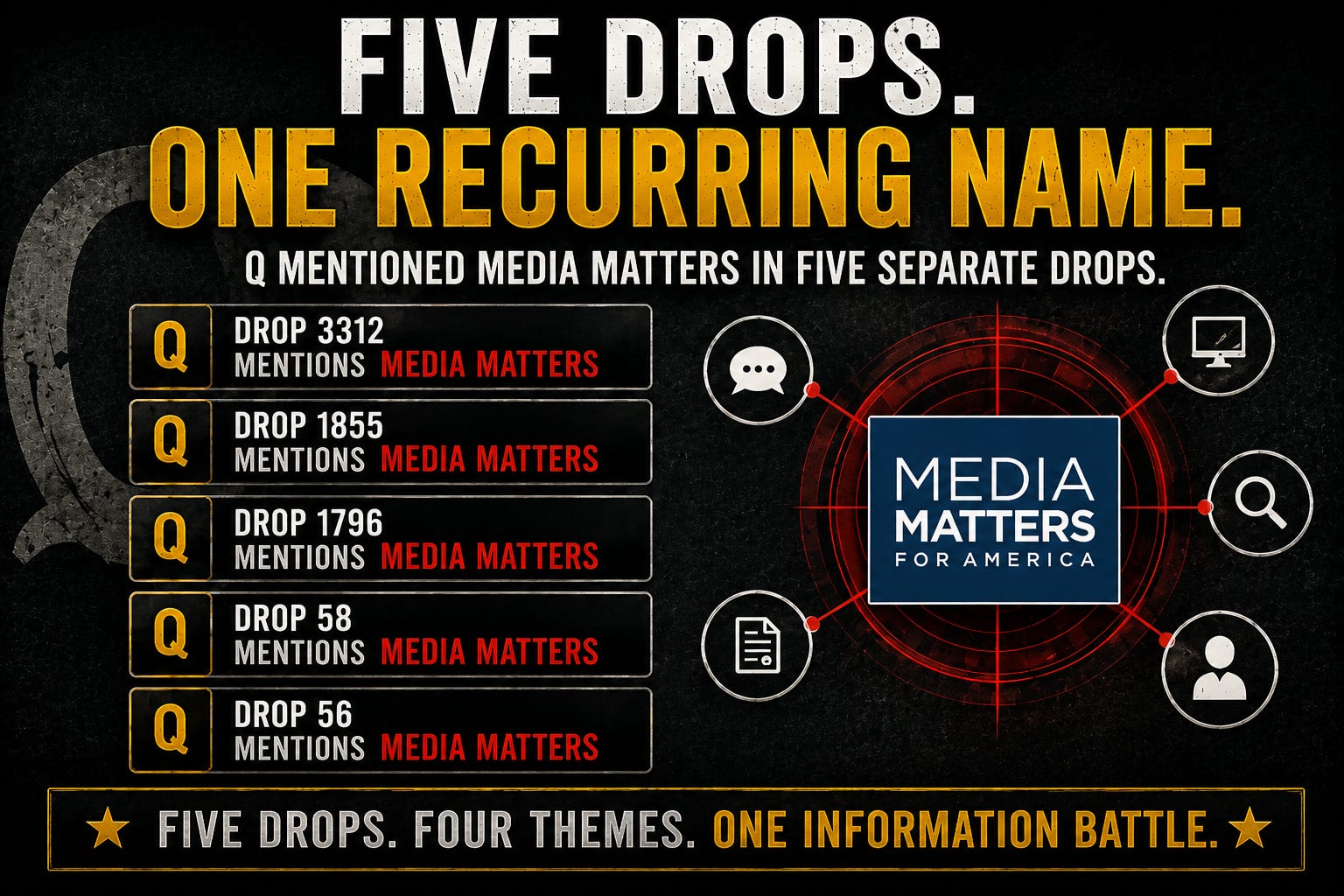
FIVE DROPS. FOUR THEMES. ONE INFORMATION BATTLE.
Put the references together and a pattern emerges inside the Q narrative.
Drops 56 and 58: Who has the authority to declare there is “no evidence”?
Drop 1796: Is ideological monitoring being presented as neutral research?
Drop 1855: Who locates, archives, and categorizes sensitive digital material?
Drop 3312: Why devote extensive institutional attention to something publicly characterized as a conspiracy theory or LARP?
What connects these themes?
The power to shape information.
That does not require a cartoonish secret room where everyone receives orders at midnight.
Modern narrative power is much more ordinary.
And perhaps much more effective.
Select the subject.
Choose the frame.
Define the category.
Apply the label.
Publish the headline.
Become the source journalists cite.
Watch the characterization travel downstream.
That’s why these drops belong in an article about Alex Kaplan and Media Matters.
They do not prove Kaplan committed wrongdoing.
They do not prove every allegation Q made or implied about Media Matters.
What they establish is narrower—and historically relevant:
Media Matters was explicitly part of the Q-era argument over monitoring, labeling, information, and narrative power.
Years later, Kaplan’s documented research remains heavily involved in analyzing and categorizing Q-related networks and activity.
That’s not a verdict.
It’s context.
And context matters.
Q mentioned Media
Matters in five numbered drops. The question isn't whether a drop automatically proves an allegation. The question is why the same organization named in an early battle over monitoring, labeling, and narrative control later became one of the most persistent institutional trackers of Q-related networks. Read the timeline. Examine the methodology. Draw your own conclusions.
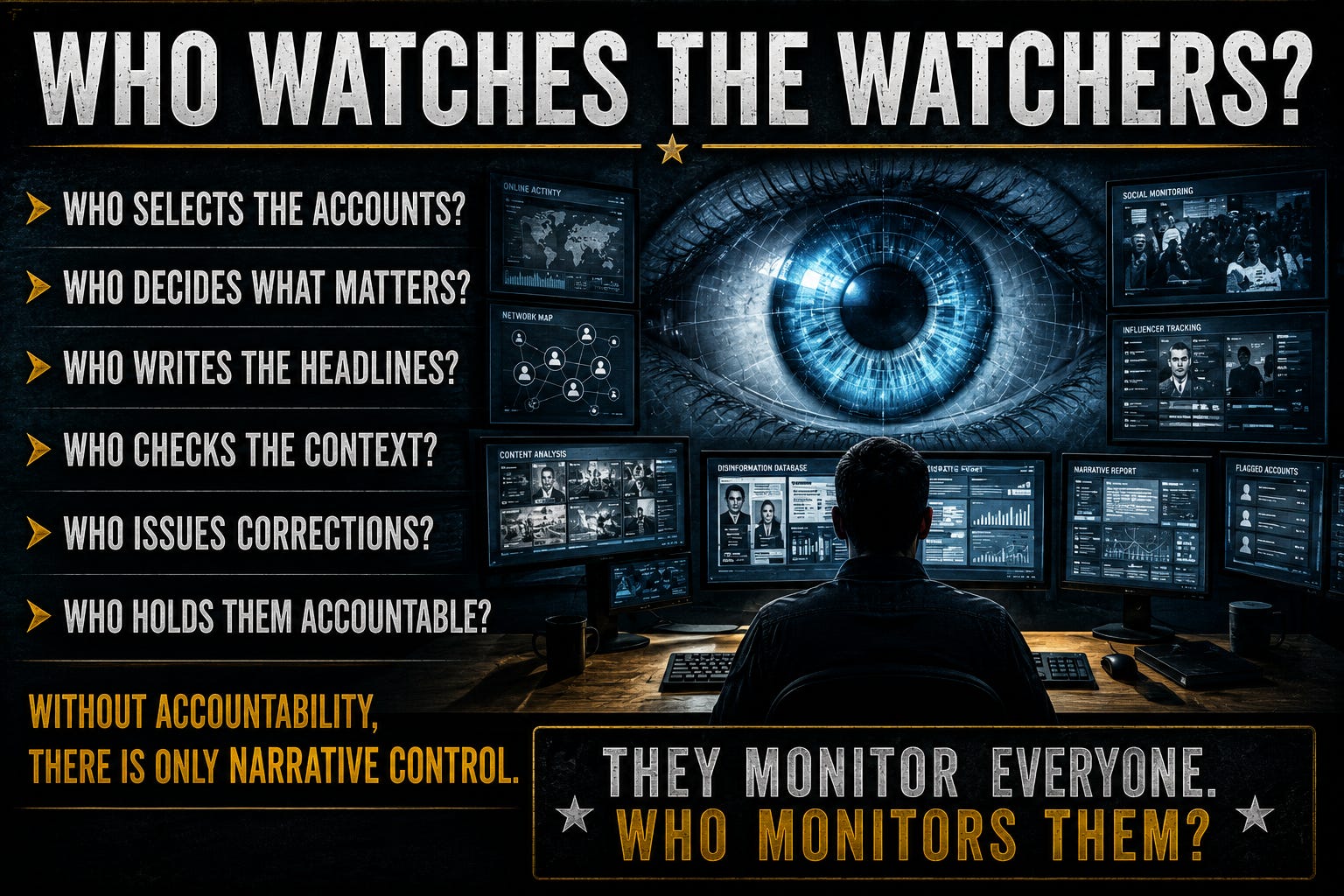
WHO WATCHES THE WATCHERS?
Media Matters monitors media.
Kaplan monitors online movements and information networks.
But who examines the methodology of the monitors?
Who examines which accounts are selected?
Who examines which screenshots are excluded?
Who checks whether the quoted post represents a person’s overall position?
Who decides which associations are meaningful?
Who defines the boundary between a Q reader and a QAnon influencer (as he refers to them)?
Who checks the labels after they have traveled through ten downstream articles?
These aren’t trivial questions.
Because labels travel farther than research.
Most people will never read a 2,000-word report.
They see the headline.
They see the characterization.
A journalist repeats it.
A social-media account screenshots it.
Someone adds it to a biography.
Another writer cites the second writer.
Eventually the original evidence disappears.
Only the label remains.
Ten people repeating one characterization do not necessarily create ten independent sources.
Sometimes they create an echo.
And echoes become extremely convincing when nobody walks backward to locate the original voice.
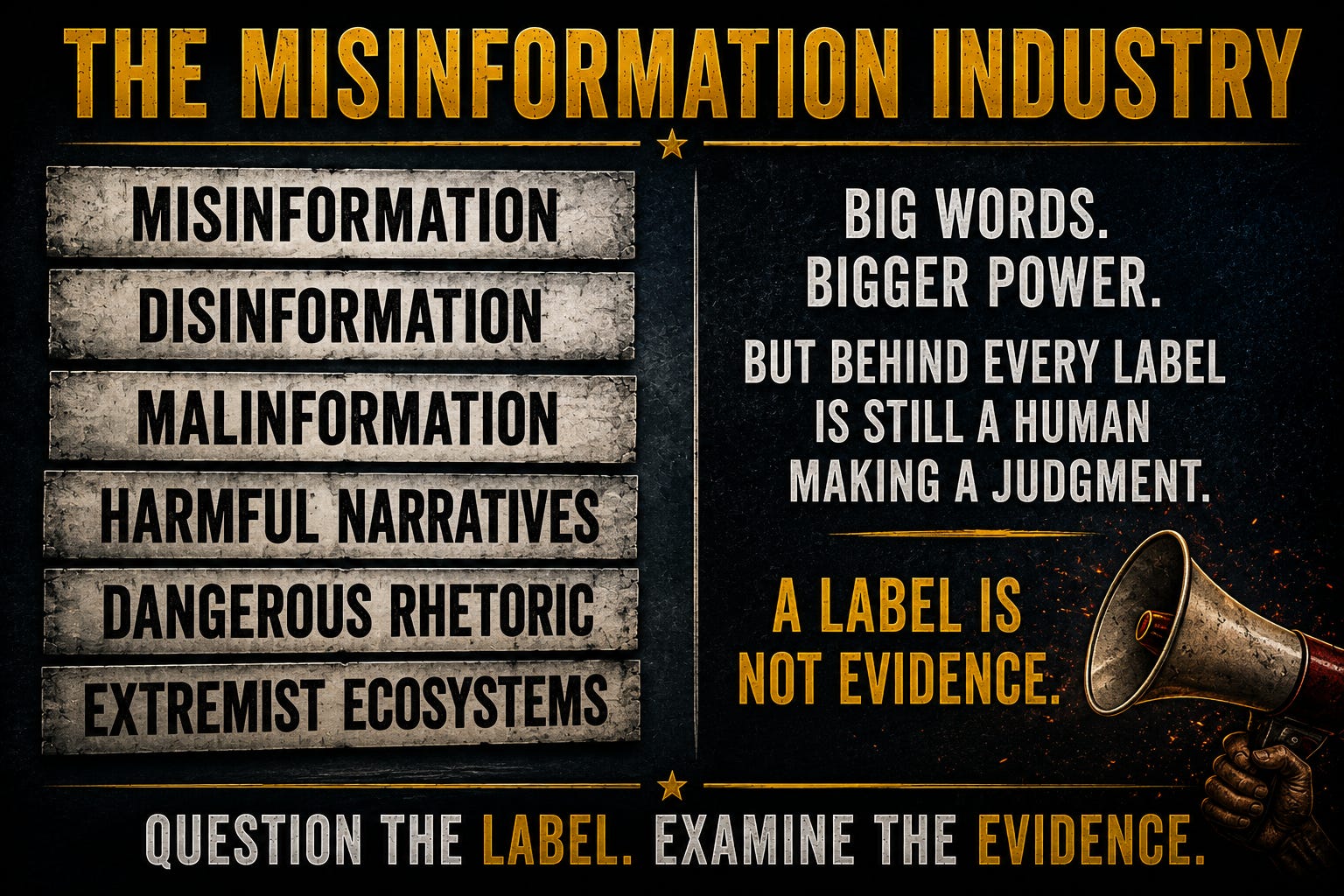
THE MISINFORMATION INDUSTRY HAS A LANGUAGE PROBLEM
There was a time when a false statement was simply challenged as false.
Someone made a claim.
Evidence was presented.
Sources were challenged.
Arguments were debated.
Now we have developed an entire vocabulary around information.
Misinformation.
Disinformation.
Malinformation.
Harmful narratives.
Dangerous rhetoric.
Extremist ecosystems.
The language sounds clinical.
Scientific.
Authoritative.
But behind every classification is still a human judgment.
That doesn’t make the classification automatically wrong.
It means the classification must remain open to scrutiny.
What exact claim was examined?
What evidence contradicted it?
Was the original claim quoted accurately?
Was context preserved?
Was the standard applied consistently?
Did later evidence change the picture?
Was a correction issued?
Those are the questions that matter.
A label is not evidence.
The word misinformation should never become a substitute for showing readers exactly what is wrong and why.
If a claim is false, demonstrate it.
If a network is coordinated, show the coordination.
If a person holds an extremist belief, document the person’s own words.
Show the receipts.
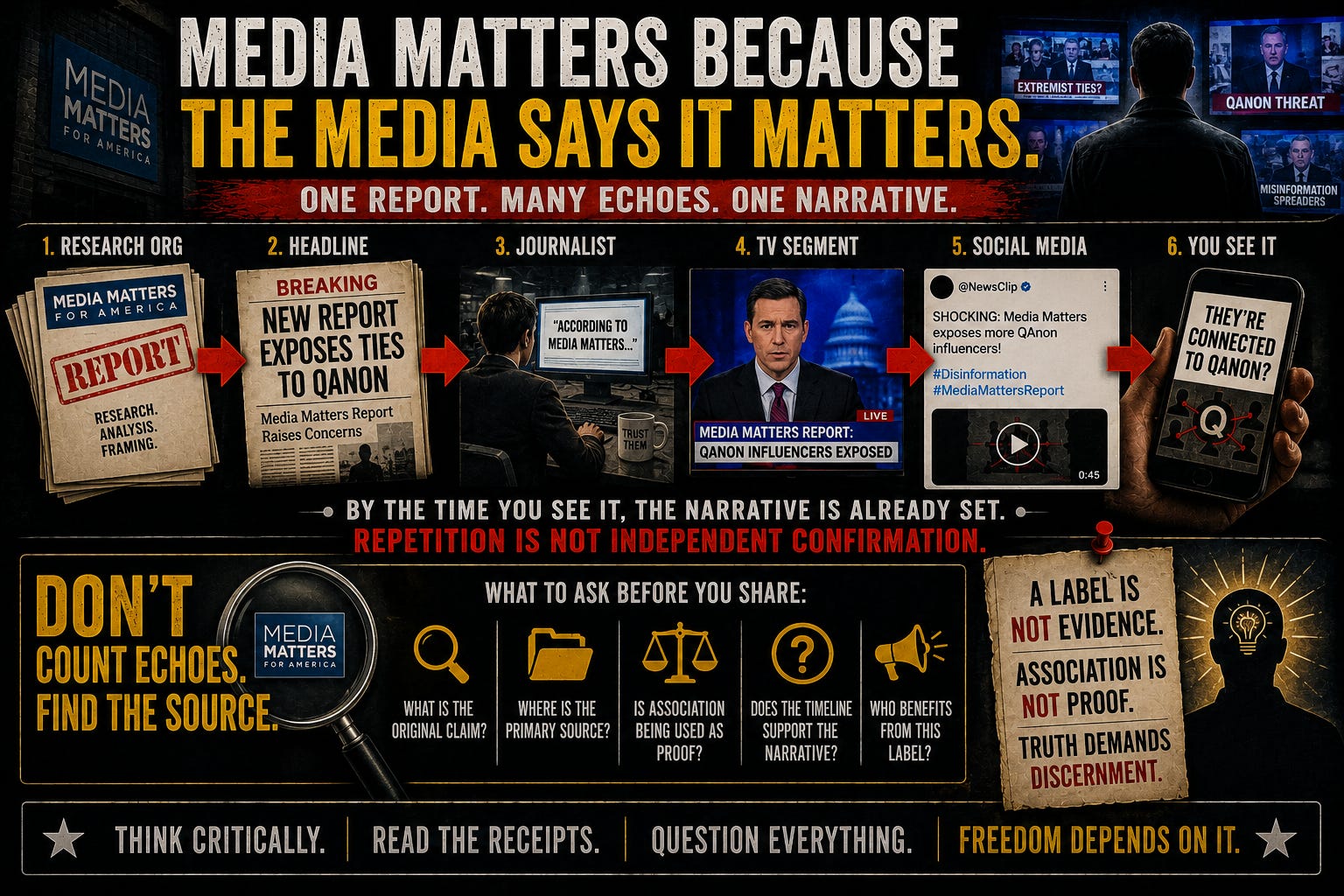
MEDIA MATTERS MATTERS BECAUSE THE MEDIA SAYS IT MATTERS
Here’s the irony.
The title of this article is:
Why Media Matters Doesn’t Matter.
But Media Matters does matter.
Not because it possesses some magical instrument capable of determining absolute truth.
It matters because its work can enter a much larger information pipeline.
Research organization.
Headline.
Journalist.
Cable segment.
Social-media clip.
Search result.
AI summary.
Suddenly an ideological characterization has traveled through enough institutions that it begins to look like independently established fact.
But repetition isn’t independent confirmation.
If ten websites trace back to one original report, you do not have ten sources.
You have one source with nine echoes.
That doesn’t mean the original report is wrong.
It means the original report deserves scrutiny.
Open it.
Examine it.
Follow the citations.
Read the screenshots.
Watch the full video.
Check the dates.
Look for missing context.
Determine whether the conclusion is supported.
Don’t count echoes.
Find the source.
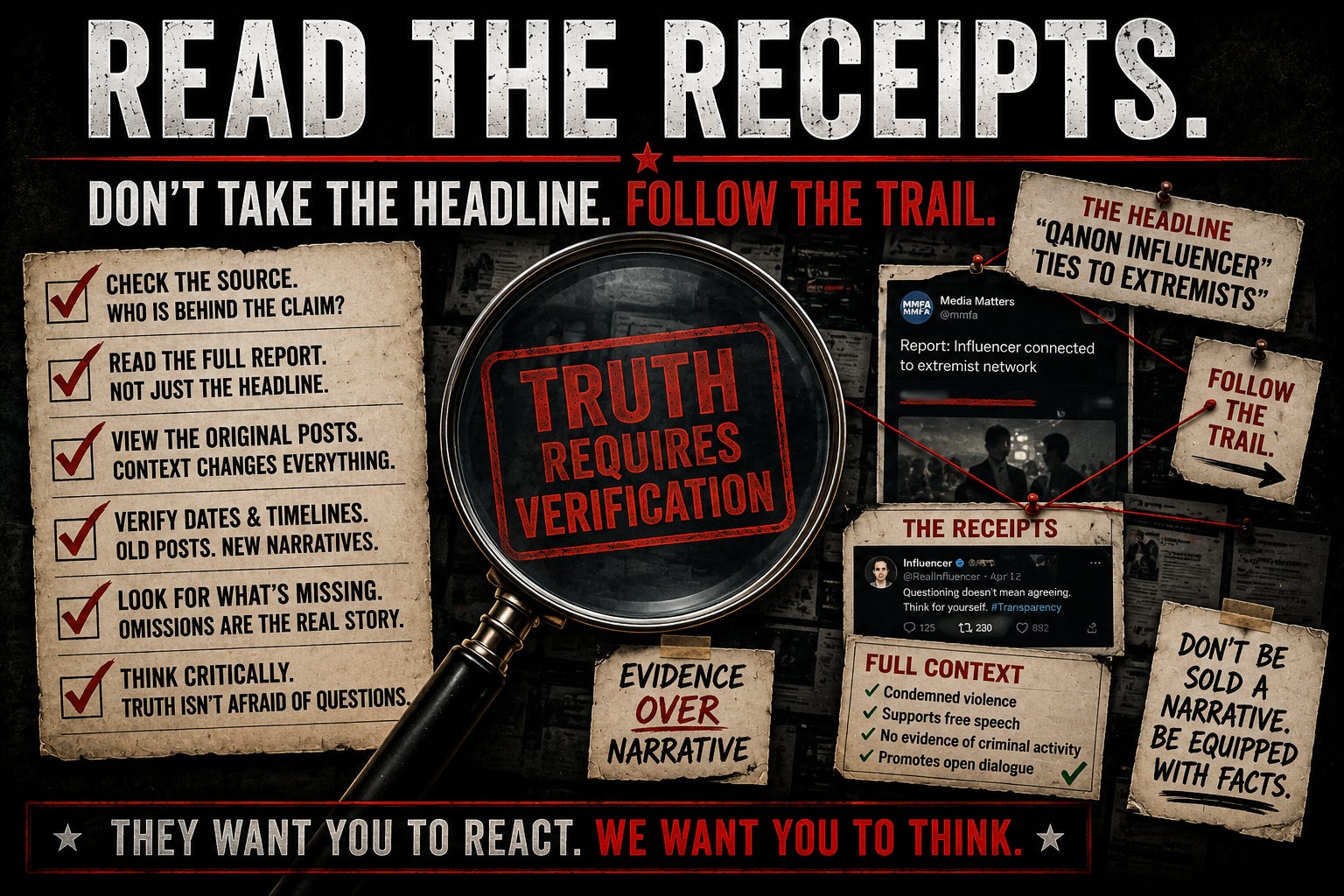
READ THE RECEIPTS
Here’s my challenge.
Don’t automatically dismiss Alex Kaplan.
Don’t automatically believe him either.
Read his work.
Open the screenshots.
Follow the source trail.
Check the dates.
Read the posts before and after the quoted post.
Ask whether the headline accurately represents the evidence.
Ask whether direct belief is documented or inferred.
Ask whether association is being used as a substitute for ideology.
Ask whether the same methodology would be considered fair if applied to the political left.
And apply that same standard to Q.
Don’t believe a claim merely because it appeared in a drop.
Read the drop.
Preserve the exact wording.
Separate questions from assertions.
Separate predictions from interpretations.
Compare the timeline.
Search for independent evidence.
Be willing to say:
“This part is documented.”
“This part is an allegation.”
“This part remains a question.”
“This part is interpretation.”
That is not weakness.
That is discernment.
The answer to biased information is not blind loyalty to the opposite side.
The answer is better scrutiny.
FINAL THOUGHT
Alex Kaplan isn’t the entire story.
Media Matters isn’t even the entire story.
Q isn’t the entire story.
The larger story is the creation of an information culture where labels increasingly replace arguments.
Where association can replace evidence.
Where ideological organizations can be treated as neutral authorities by downstream media.
Where a headline can define a person before the reader ever hears them speak.
Where the word misinformation can become more memorable than the original claim.
And where people on every side are tempted to trust conclusions that confirm what they already believe.
The danger isn’t that Media Matters exists.
It has every right to conduct progressive media research.
The danger begins when audiences forget the organization’s stated perspective while treating its characterizations as viewpoint-free conclusions.
Likewise, the existence of five Q drops mentioning Media Matters does not automatically validate every allegation contained within them.
But the references are historically relevant.
They show that Media Matters was already part of the argument over monitoring, labels, digital trails, and narrative power in the Q era.
Then came years of Media Matters research documenting Q-related communities.
That timeline deserves examination.
Not worship.
Not dismissal.
Examination.
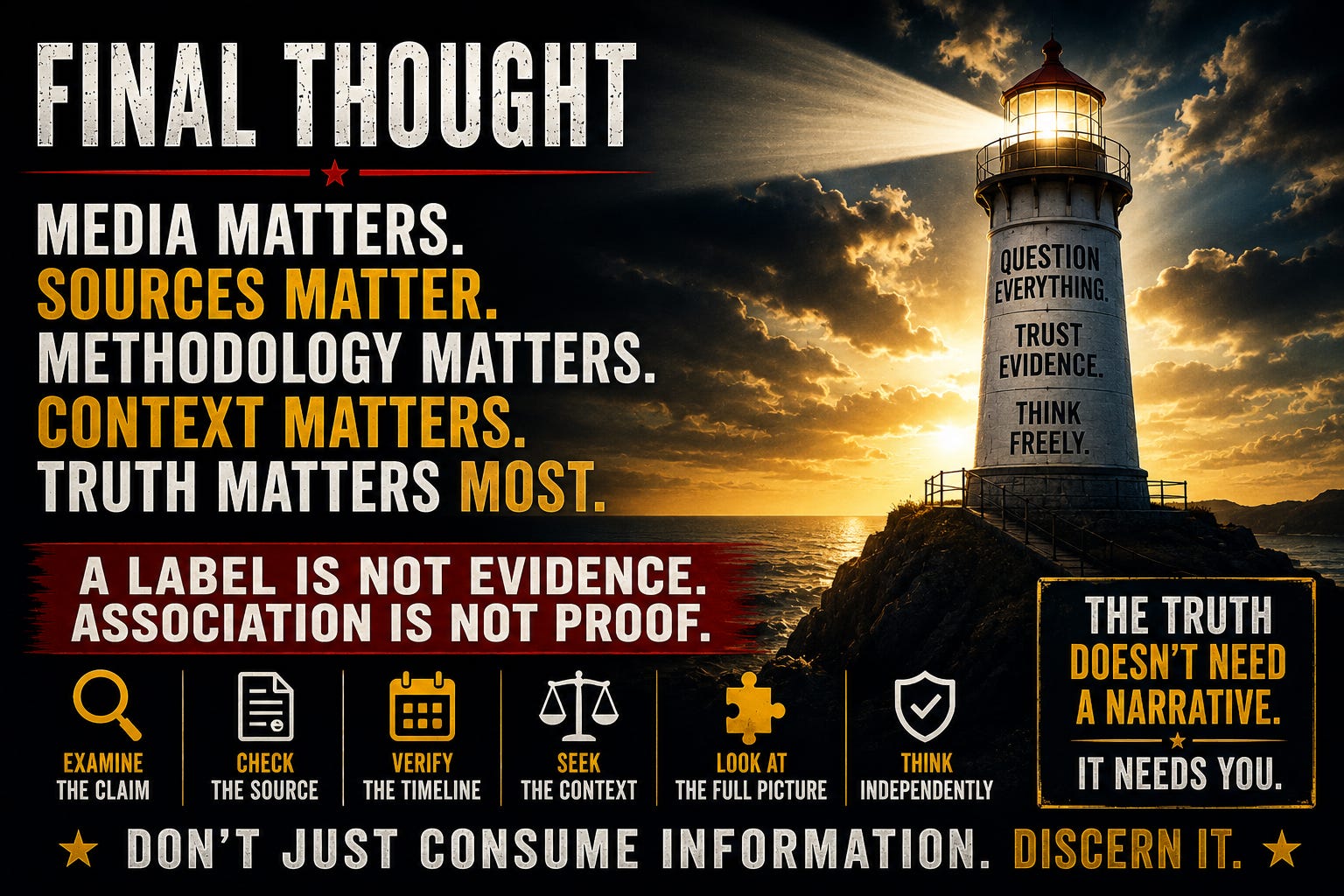
Media matters.
Sources matter.
Methodology matters.
Context matters.
And truth matters most.
A label is not evidence.
Association is not proof.
A question is not a conviction.
And repetition is not independent confirmation.
Read the timeline.
Examine the source.
Check the methodology.
Then draw your own conclusions.
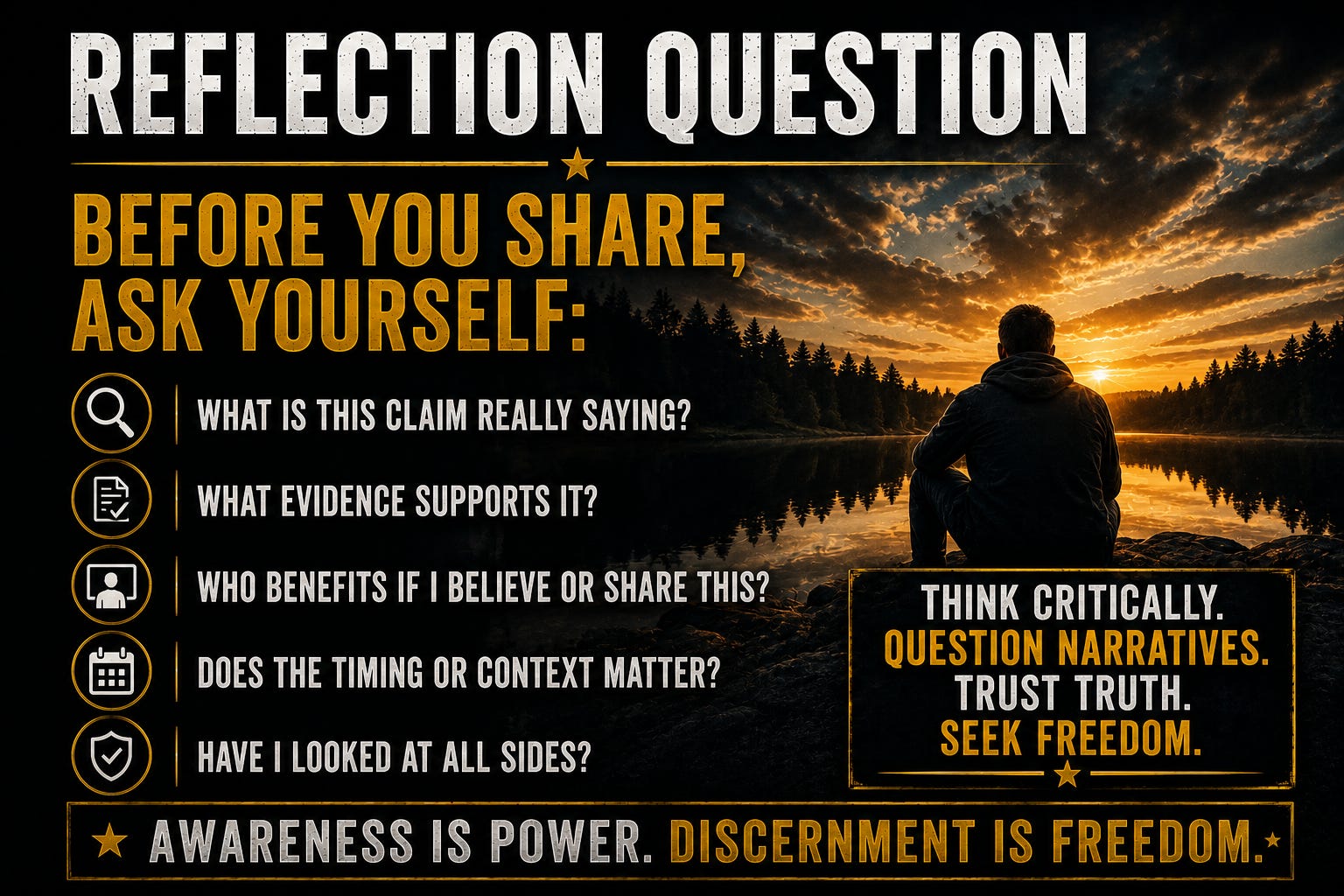
REFLECTION QUESTION
When you see someone labeled an “extremist,” “conspiracy theorist,” “QAnon influencer,”(as they refer to it) or source of “misinformation,” do you examine the original evidence—or do you trust the person who applied the label?
Before you share, ask yourself:
What is the claim actually saying?
What evidence supports it?
Am I looking at a primary source?
Is association being presented as proof?
Does the timeline support the narrative?
Have I examined the other side’s strongest argument?
Awareness is power.
Discernment is freedom.